
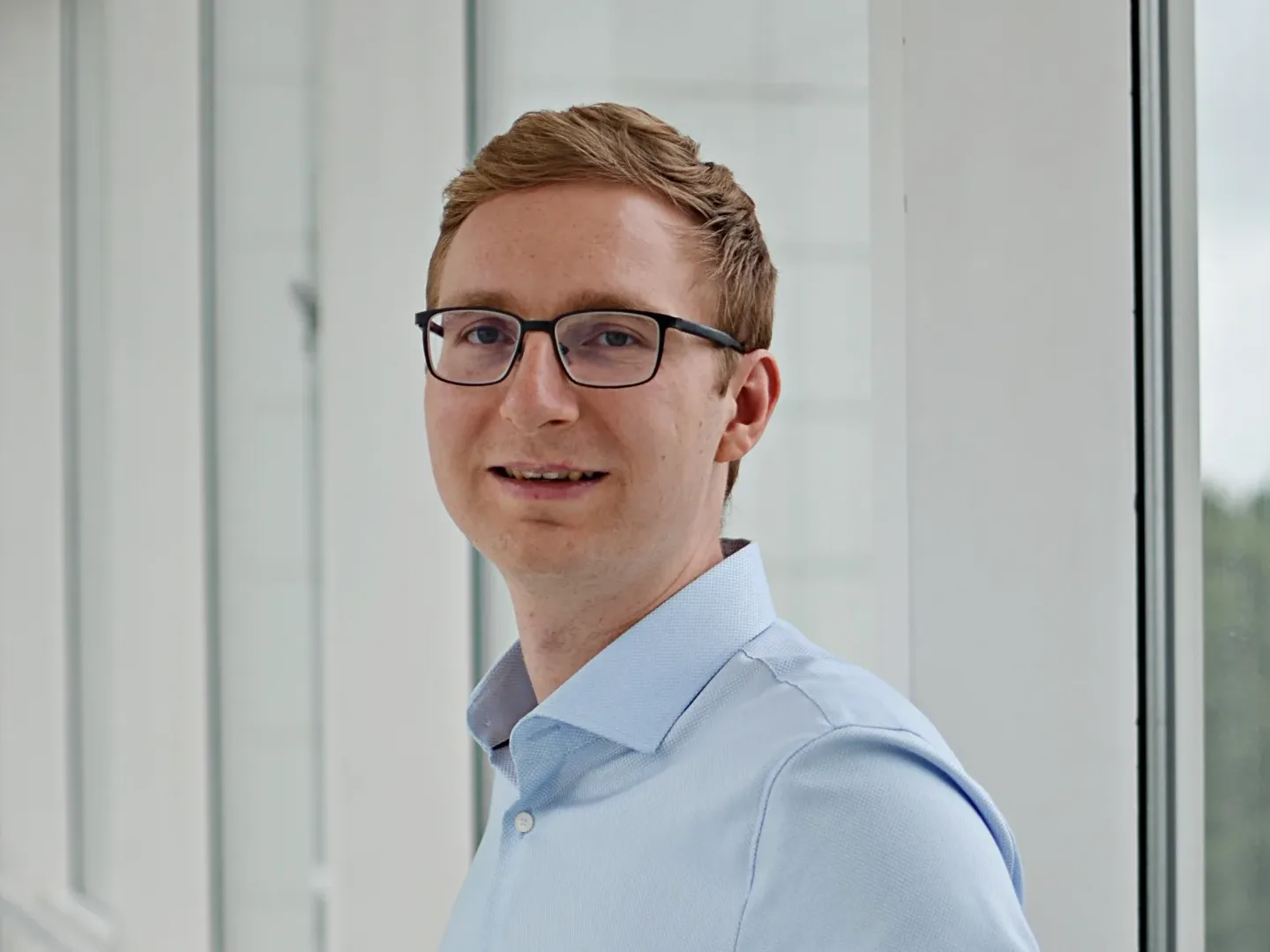
High-performance batteries are essential for electric mobility, the stabilisation of electricity grids and many other applications of electrification. Lithium-ion batteries are widely used today, but the batteries of the future must be more powerful, age more slowly and be lighter. Marvin Gajewski is investigating how one of the biggest sources of error in quantum computing can be put to good use in this regard. He is a PhD student at the DLR Institute of Technical Thermodynamics and a member of the BASIQ project. In this interview, he discusses the recent publication co-authored with Alejandro Somoza, Michael Marthaler from HQS Quantum Simulations and BASIQ project leader Birger Horstmann. In it, the researchers demonstrate how they are specifically utilising quantum noise to simulate battery materials.
Why are you so keen on battery optimisation?
Batteries are key to the energy transition and to electric mobility. I want to conduct research into something that has a tangible benefit for society. And a practical focus is important to me. In the Algorithms team, we focus very strongly on concrete technical applications, which gives us insights into many different areas of quantum computing. The DLR QCI offers the ideal conditions for this: we work closely with hardware manufacturers and can follow the development of the technology first-hand. I also find the collaboration with industry partners such as HQS particularly exciting. I’m learning a great deal about how research and industry work together. It’s a privilege to be doing my PhD in this environment.
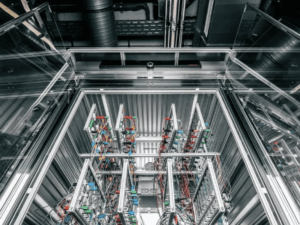
BASIQ – Battery material simulation with quantum computers
BASIQ simulates battery materials at the atomic level and battery cells at the continuum level using quantum computers from the DLR Quantum Computing Initiative and adapts the quantum simulation to specific hardware.
What findings have you recently published in the journal Nature?
In our paper, we investigate the dynamics of electrons – in other words, electron transfer. To this end, we have developed an algorithm that allows us to track how electrons move through a material. We demonstrate that this approach works on real quantum hardware. The central idea of our paper is to make targeted use of the noise on the quantum computer: noise – that is, computational inaccuracies – is normally regarded as one of the greatest challenges in quantum computing because it leads to errors. The central idea of our paper is to make targeted use of the noise and treat it as a resource.
An ideal quantum computer without noise would be a closed system in which, for example, energy is conserved. Real-world batteries, however, are open systems. In such systems, heat loss, friction and other interactions with the environment occur. Noise also turns a quantum computer into an open system. Put simply, noise can be compared to energy loss in a battery. Mathematically, both situations can be described using the same formalism. We have therefore developed an algorithm that utilises noise as a feature rather than a source of error, and we are now publishing the results in the journal Nature.
What are the biggest challenges when it comes to simulating batteries?
Simulation helps us to use experiments in a more targeted way, as experimental data alone often does not tell us much. It is often only through suitable models that we come to understand the physical processes underlying the measured values. One of our greatest challenges lies in the boundary layers of batteries – for example, the interface between the electrode material and the electrolyte. Processes at such interfaces are difficult to resolve using conventional simulation methods. At the same time, there are still many physical phenomena occurring there that we do not fully understand. It is precisely these issues that our group is working on. We share our findings with industry, where batteries are developed and manufactured.
Which materials are currently of particular interest?
At present, lithium-ion batteries remain a major focus of attention. This often involves optimising various additives and combinations of materials. At the same time, intensive research is being carried out into entirely new battery concepts, such as those based on sodium or lithium-metal systems. Such alternatives can offer advantages in terms of availability, supply chains and sustainability. In recent years, geopolitical factors have also played an increasingly significant role in the selection of materials.
What do you take away from your work and apply to your everyday life?
Ever since I’ve understood how batteries work, I’ve actually found myself thinking more often about charging my mobile phone in good time. As a general rule, for many rechargeable batteries, keeping the charge level between about 20 and 80 per cent is particularly gentle on them. That’s why I make sure my battery doesn’t run completely flat. This extends the battery’s lifespan.


