

It is a complete product and not an improved sub-process that the ALQU project team presents together with HQS in a new paper: “Quantum Simulation of Magnetic Materials: from Ab-Initio to NISQ” shows how all work steps were developed with know-how from the DLR Quantum Computing Initiative (DLR QCI): from the ab-initio electron structure calculation of two-dimensional magnets and modelling to simulation on real quantum computers. They thus demonstrate a physically meaningful simulation for real, potentially industry-relevant materials.
A workflow for improved studies
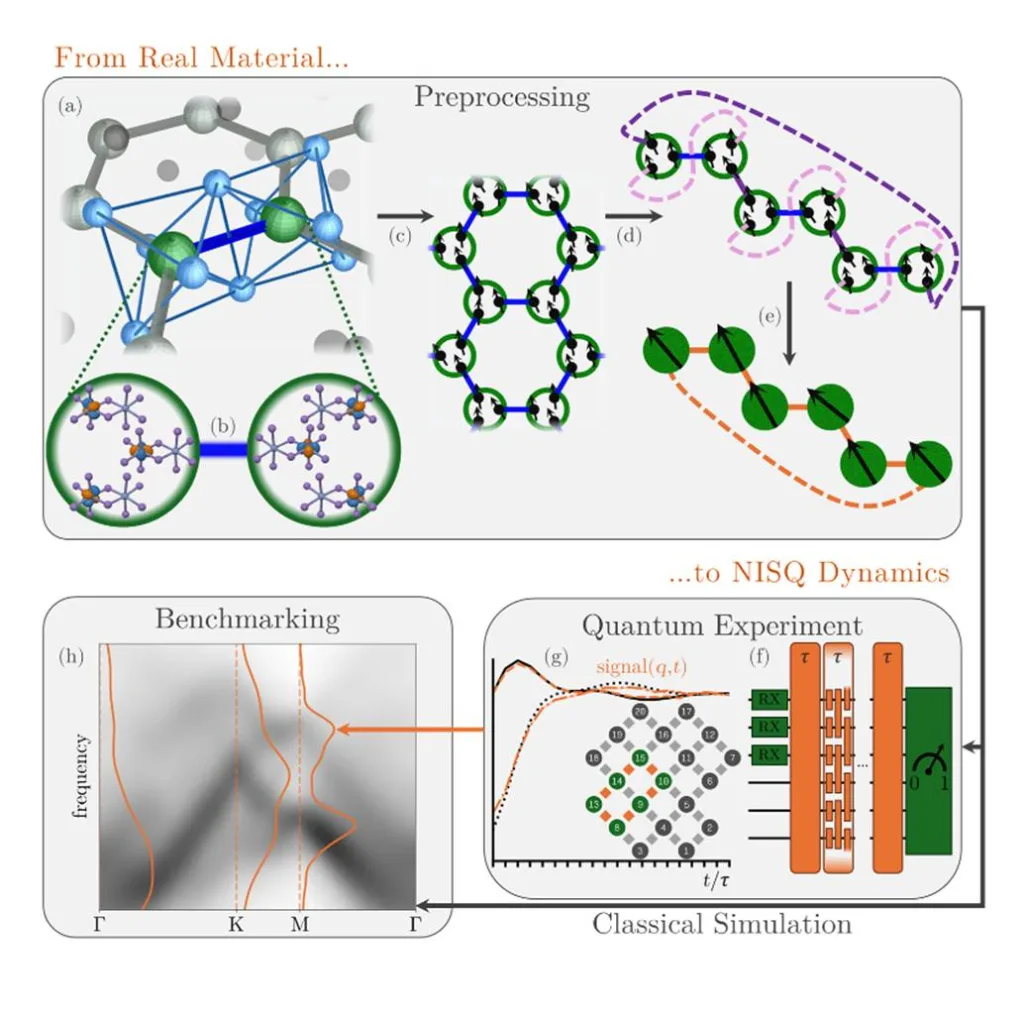
In the paper, the researchers illustrate how they derived an effective spin model from first-principles calculations and use it to simulate low-energy magnetic excitations on quantum hardware.
They achieve systems with up to 48 spins. Classical simulations are becoming increasingly demanding in this area. On our behalf, our industrial partner HQS GmbH has worked with us to develop a coherent workflow that is also designed to make studies on real materials for quantum components more systematic and reproducible in the near future. The process was simulated on IQM quantum computers with cloud access. In the future, such a workflow will also be realised on DLR QCI hardware.
Proof of quantum utility thanks to German research
The paper is not only the product of successful teamwork, but also shows that Germany as a location combines the necessary expertise and technology for quantum computing to provide effective international impetus. Quantum computing is applied to realistic materials with potential industrial relevance. The end-to-end workflow demonstrated by ALQU and HQS for the first time is proof of quantum utility, with the limitation that it was carried out on faulty hardware that is currently available.
On the software side, the workflow combines open-source software and tools developed by HQS: PySCF and Active Space Finder for the electronic structure and active space phase, HQS Spin Mapper for the preprocessing of the resulting spin model and HQS Quantum Solver for classical Krylov-based benchmarking, complemented by DMRG reference calculations. Together, these components form the computational backbone of the end-to-end approach presented for the first time in this paper.


