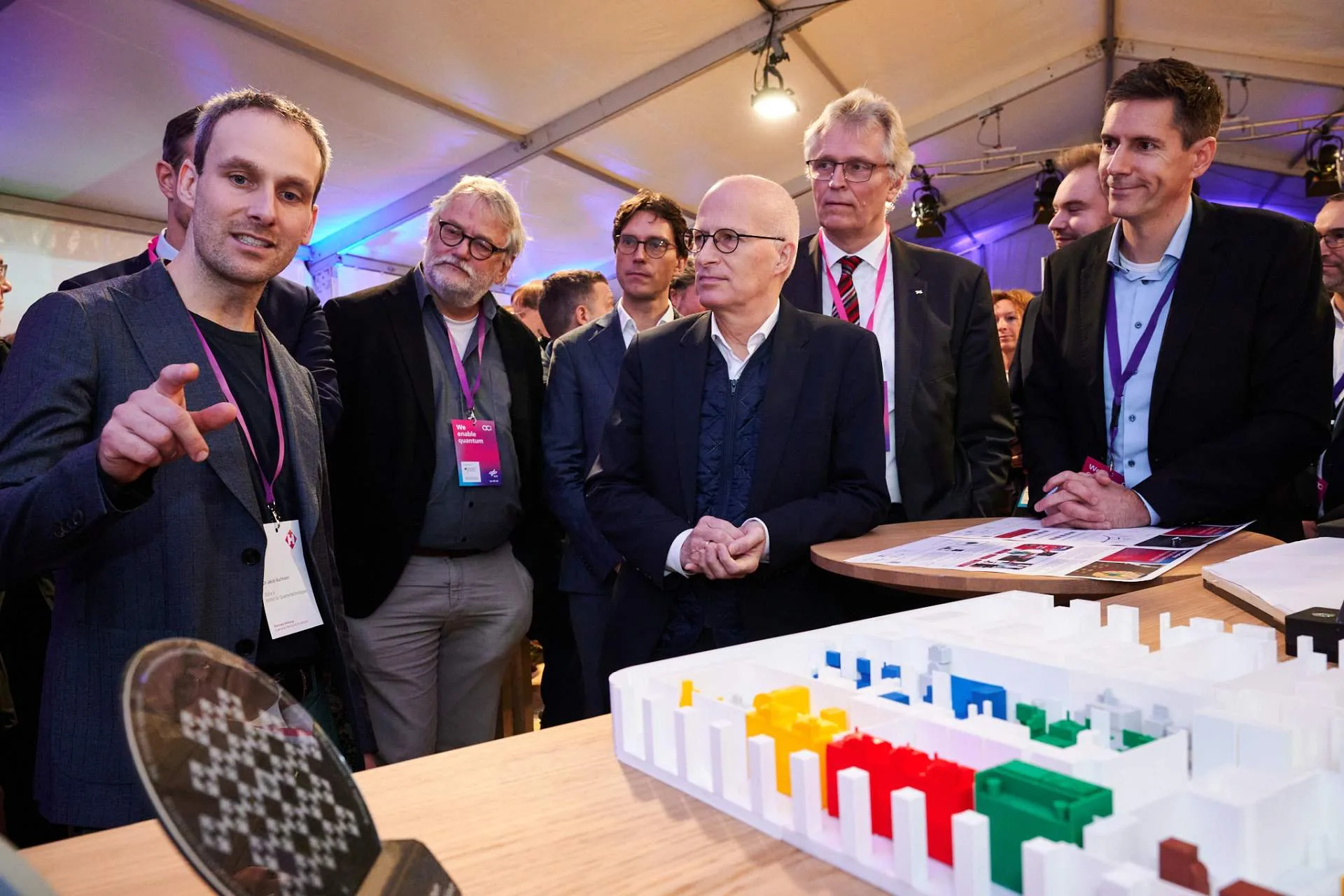
Jakob Buchheim has been fascinated with working in cleanrooms for a decade before he took on his biggest challenge: Building a user facility for highly skilled deep tech start-ups at our Innovation Center Hamburg.

Jakob, let‘s start with a stupid question: Are all cleanrooms the same?
No, of course not! The term cleanroom is often used in a very general way. But in reality, it involves many technical details and concrete decisions. To build the cleanroom in Hamburg, we had to understand what was actually needed. That is one of the biggest challenges, especially at the start, when it is not yet clear what companies want to realise in concrete terms.

So our first step was to identify the requirements the cleanroom and the integrationtechnologies would have to meet. This is where the details matter. For example, if silicon is to be deep-etched or other semi-conductor materials are used as base substrate, or metal films are to be evaporated, you need to know excactly whichmaterials will be processed and which substrates will be used. These technical requirements are crucial because all process steps in the cleanroom’s overall process chain have to be compatible with one another.

© Samuel Mindermann für DLR QCI 2026

What were the constraints you had to work with in Hamburg?
Basic framework conditions such as fire protection were already covered by the building’s existing infrastructure. At the same time, the limited space was the real challenge. It turned the planning process into something of a puzzle – and made it highly demanding.

When you design a cleanroom you want it to cover the complete process chain: from the starting substrate, for example a silicon wafer or glass wafer, all the way through to the finished component. It is not enough to carry out only some of the necessary processes on site and outsource others. The individual process steps and materials are too closely interdependent. Outsourcing would also create considerable waiting times and organizational overhead. In microfabrication, certain methods are often used repeatedly at different points in the manufacturing process. In other words, during layer build-up, you return again and again to process steps that have already been used. That is why the entire process chain has to be available in the cleanroom and carefully coordinated.

So the clear requirement was: all processes needed by the companies had to be available on site. Under the spatial constraints we had, that made the planning particularly complex

In the end, we had to integrate 35 specialised systems. That allows us to cover the complete process chain. But such systems are usually not exactly space-saving.

Did it become easier after that?
No! The initial phase was particularly demanding, for several reasons. One challenge was that, at the beginning, only a small number of people had extensive experience in microtechnology and microprocess chains. The DLR QCI financed the implementation, but the essential knowhow came from us, because our department was the only one at DLR with relevant prior experience.

So we were not only responsible for shaping the technical implementation. We also had to provide the expert basis for many fundamental planning considerations and decisions. This did not only involve selecting and integrating the systems, but also defining the requirements for the laboratory layout and the adaptation of the infrastructure at the IZHH. And I had to coordinate all the work from Ulm. The situation became much easier only after I was able to hire a very experienced colleague who took over the work in Hamburg. Having a team member directly on site made many processes easier and the implementation much more efficient. That said, we still need qualified staff. Finding and retaining them in the long term is also a major challenge – that we share with many start-ups.

What makes a good cleanroom team?
For a project of this scale, you need people who are willing to fully engage with the task under the given conditions and take responsibility.

We were very lucky with the appointment of the laboratory management. They embraced the challenge and the responsibility with great commitment and have continuously built up the Hamburg team since March 2023. He is supported by technicians and process engineers who gradually commission the systems, operate them and further develop the manufacturing processes. The team also includes technical assistants responsible for the plant technology and building interfaces, two process engineers who develop and supervise systems and processes, and a researcher who supports companies in particular with consulting and the integration of processes along complete process chains along with four additional team members who share some machine operation responsibility alongside mastering their technology development projects. Overall, we now have a highly capable operating team that successfully runs and continues to develop the cleanroom. One of our strengths is our interdisciplinary set-up. We have engineers from various disciplines, materials scientists, electrical engineering specialists and physicists. This diversity is necessary to develop microtechnological systems and processes for quantum systems. It also makes collaboration easier, because we, other researchers and companies often bring different perspectives and specialist languages to the table.

And what unites you?
We all share a fascination for microtechnology: manufacturing structures with the highest precision, structures that are often only visible under a microscope in the end. I have been fascinated by working at this tiny scale, using state-of-the-art infrastructure, for 15 years now.

We also all feel that we are contributing to something new – something that could really make a difference. That mindset is a central part of our work. There is no fixed recipe. We are working on a highly innovative overall system in which many things still have to be developed. That creates a strong bond within the team. We are not simply implementing individual projects. We are helping to create a building block for a new generation of technology.

It‘s working at the frontier…
In quantum technology, a great deal is still driven by highly motivated individuals. Often, teams believe in their ideas with a lot of conviction and energy, even though it is not yet clear whether market success will actually materialize later on. Unlike in established industries, there are often no reliable market models or clear specifications yet, such as those found in the automotive or semiconductor industries. That means everyone involved has to be strongly intrinsically motivated and work on these developments out of conviction. This is exactly what shapes our team in Hamburg.

And we are united by one central task: designing and successfully carrying out what are known as flows. That means planning and implementing the process chain – the sequence of individual, interdependent manufacturing steps – from the starting substrate to the finished component.

When you built the cleanroom, did you simply fulfil the requirements of the partner companies?
Well, it was not quite that simple. During the contract and procurement process of the DLR QCI’s quantum computers, the companies were able to contribute requirements for the DLR infrastructure and therefore also for the cleanroom. But with some of the companies, often young start-ups within the DLR QCI, the process was more educational. Together, we developed suitable process chains and boundary conditions and assessed whether these would be viable for the companies.
Other companies had patent-related constraints, because certain process details or technologies for producing surface structures are protected or confidential. As a result, they could not pass on all the information we would have needed. And some companies already had very concrete ideas and were able to describe individual processes clearly. But they were the smaller group.

In practice, this meant that we had to develop a consistent overall concept from very different starting points and derive concrete process plans from it. A lot of interpretation and design work therefore lay with DLR.

So you are also building up expertise?
Yes, because the project is closely linked to our own development mission. Four researchers were hired in Hamburg to develop our own technology packages in the field of ion traps. This strengthens our internal know-how and is complemented by a team of additional ten cleanroom researchers at our Ulm site.

This approach is central to DLR. We are not a pure foundry with clearly defined standard services. We operate between a university cleanroom and industrial manufacturing. The goal is to act as a development partner and provide concrete process and technology expertise, so that companies can focus on their core competencies, such as building quantum computers.

To do this, we also have to conduct our own r&d work in the cleanroom. That is the only way to build up the knowledge we need and actively contribute to shaping the processes! This dual role as infrastructure operator and development partner allows us to sharpen requirements and establish the cleanroom as a pilot line. It can now support both production and development and, in the long term, represent the innovation cycle in this field.

Will further expansion of the cleanroom require more systems, more staff or both?
The cleanroom is clearly needs-oriented. At its core, it is about solving concrete problems for companies and enabling them to do their work. If demand increases, we can respond accordingly. The investments in the infrastructure have already been made, so the basic foundation is in place. The decisive lever is then staffing. If more specialists are available, more processing technologies can be offered and significantly more users and companies can be supported.

But that is not easy. We are talking about highly specialised microproduction systems that require continuous supervision. On average, a process engineer should spend around one to two days per week on each system to ensure operation, process stability and further development. That means one person can realistically supervise no more than five systems in the required depth. If a process engineer is responsible for more systems, this inevitably comes at the expense of the depth of support or the performance of the processes. That is why available staff capacity is a decisive factor in how many systems and companies can be supported at the same time.

We deliberately chose our current approach. The goal is not to provide as many resources as possible, but to operate the available systems with the necessary technical depth and quality. Especially with complex microtechnology processes, intensive support is a key success factor.

Which systems and tools do you use?
A central element in the microproduction chain is patterning, meaning lithography. For this, we use two established methods. The first is a laser lithography system, which transfers a design directly onto the substrate. Think rapid-prototyping system or 3D printer. What matters here is a serial but still fast writing process that enables us to produce structured wafers efficiently. The second is UV lithography, especially for higher quantities. For ion-trap applications, nanometer-scale structures like those in classical computer chips are not required. Micrometer dimensions are entirely sufficient. This combination of laser and UV lithography is therefore a very established and suitable cleanroom standard.

One particularly specific system is the electroplating tool. It enables the deposition of very thick metal layers, which are needed for the conductive structures of ion traps. These layers are essential, but electroplating systems of this kind are not found in every cleanroom.

Another special system is a cryogenic wafer prober. It allows us to test components under realistic operating conditions, similar to those they will later encounter in an ion-trap quantum computer. For metallization, we also have two additional methods available: an evaporation system and a sputtering system. Both are used to deposit metal films, but they differ in their physical properties and therefore also in the resulting material properties, such as crystal structure or homogeneity.

How are the individual steps in this process chain connected?
Take thermal sensitivity, for example. If a metal has been deposited by electroplating, the substrate can often only be exposed to temperatures below around 150 degrees Celsius afterwards, otherwise the material properties may change. We have to take such interactions into account in the overall process design.

That is precisely why the individual system is not the only decisive factor. What matters is the interplay within the “flow”, meaning the complete process chain from substrate to finished component. We want to develop stable and reproducible processes, for example for conductive layers, insulation layers or precise electrode structures. This is where the cleanroom’s added value lies: we combine microtechnology expertise, develop stable processes for ion traps and make them available as a reproducible foundation.

Is this just one cleanroom among many?
I believe our cleanroom in Hamburg is highly special. In 2025, the EU made a specific investment decision under the Chips Act and launched a Europe-wide call to develop a pilot line for the production of ion traps. Around 45 million euros were to be provided. When I read that, my first thought was: in principle, that is exactly what we already have. And it shows how important this kind of infrastructure is.

Classical chip manufacturers are designed not to constantly change stable and highly optimised processes. Their processes are often worth millions and are therefore not intended to address experimental materials or new effects such as motional heating in ion traps.

What is motional heating in ion traps and why is it important?
Motional heating in ion traps refers to unwanted heating effects in trapped ions, which are believed to depend strongly on the material, surface structure and manufacturing process of the metal layers. The exact causes have not yet been fully investigated, but the DLR QT-IMN team is working on them.

For questions like these, there is so far no established market in the industrial environment. And that also means there is no suitable production infrastructure – no environment in which new technologies can first be developed, tested and iteratively improved. So we take the technological basis and transfer it to new physical systems and requirements. But this is not a simple transfer. It is more of an evolutionary development, because many processes are not directly compatible. This is precisely where gaps emerge – gaps that require specialised pilot lines.

And you can close these gaps?
Exactly. We want to provide an infrastructure that is explicitly designed as a user facility for companies, enabling them to develop their technologies further while outsourcing complex process development. This applies both to ion traps in Hamburg and to our activities in Ulm, where we have established a similarly specialised infrastructure in the field of diamond-based quantum systems. In both cases, the special feature is the combination of highly specialised microtechnology, a targeted focus on quantum systems and an infrastructure model that is deliberately positioned between a research institution and an industrial development platform.


Why don’t companies simply build their own cleanrooms
Because it is far too expensive. In Hamburg alone, we are talking about investments of around 30 to 35 million euros to build this infrastructure. That is a scale that is hardly feasible for Startups. Even with venture capital, such a set-up would hardly make sense, because it does not directly serve the actual business case. Initially, it only creates infrastructure. In addition, a single Startup usually could not make full use of this infrastructure. Even with ten employees, such a facility would only be used in part. It would make sense only if around 30 to 40 people were intensively working on different processes.

That is why our approach is not to build this infrastructure separately within individual companies, but to provide it centrally as a shared cleanroom infrastructure. Companies therefore do not have to shoulder this high entry barrier themselves. Instead, they can access a shared platform to further develop their expertise.

Do other providers do this as well?
Strong German players in the field of microtechnology often work according to a contract-manufacturing model. The processes are externally defined, carried out and then delivered. That is a completely different model from our user facility.

Our approach is more collaborative. Companies work directly in the cleanroom, develop processes further together with us and build up their own knowledge. Especially at an early stage of innovation, for example in quantum systems, this is crucial. Many companies cannot yet specify their processes in sufficient detail, or they deliberately do not want to hand over detailed process knowledge. This is the niche we serve: not pure service provision, but joint development.

Could universities not fulfil this role?
Compared with university cleanrooms, our focus is much more strongly on process stability and systematic development. University cleanrooms are often highly project-driven and dependent on individual PhD projects. As a result, there is often no overarching view of complete process chains and their stability. Our goal, by contrast, is to develop and document processes in such a way that they are transferable. Once a method works and is stable, it should be described so clearly that it can also be reproduced in other infrastructures, such as an industrial foundry.

The decisive point is this: the step from “it worked once” to “it is reliably reproducible” is enormously demanding and often more resource-intensive than the first demonstration itself. But it is precisely this scaling and stabilization phase that is crucial for companies if they want not only to demonstrate products once, but to manufacture and sell them reliably over the long term. In that sense, we take on a bridging function. We develop processes together with companies to the point where they can be transferred to industry, without becoming a foundry ourselves.

Our goal is not to become a new production provider, but to enable a new industrial sector, especially in quantum technology, in the first place. Ultimately, that is the core of the idea: to use publicly funded infrastructure in such a way that new markets can emerge in the long term, where companies can then create value independently.

But does that not mean innovation remains dependent on public funding?
For me and my team, the next clear milestone is to have paying customers. That means companies saying: this cleanroom and the processes you offer here are worth contracting. That would not only validate our work, but also be an important step for the entire ecosystem.

Many companies in the field of quantum systems, whether sensors or quantum computers, are currently still very vertically integrated. They develop everything themselves, from the chip to the software, and have to maintain expertise in many areas at the same time – for example in microfabrication, electronics or laser development.

I do not believe that this model is viable in the long term. A sustainable ecosystem only emerges when specialised partners work together. We, as experts in microtechnology, provide stable processes and development support, while the companies can focus on their core competencies. A good signal for us would be companies being able to develop chips and processes with us with relatively little overhead, trusting our expertise and focusing their own resources more strongly on design and system development. After a certain development period, they could then take their IP and have it produced in series by an industrial manufacturer. When we reach that point, it would be the ideal case for us: we would function as an incubator and development partner within an innovation cycle that later transitions into industry.


But then you would run out of work.
No, quite the opposite. Scaling is still at a very early stage, and especially in ion traps, many future problems will be strongly rooted in microtechnology. Current systems are being developed in the range of fewer than 100 qubits. In the coming years, we will be looking at systems with hundreds of qubits. This will create entirely new technological challenges, because as the number of qubits increases, so does complexity. Larger systems require many electrodes and voltage sources that have to be integrated and controlled. Classical external control quickly reaches physical and technical limits here.

That is why it will be necessary to integrate more logic and control directly on the chip in order to keep this complexity manageable. Similar challenges also exist in optical control, for example in the integration of waveguides for laser manipulation. This means that even if the ecosystem develops successfully, there will still be a great deal of need for innovation. With the infrastructure we have now built, we can actively help shape these next generations of challenges.

Do other research fields also benefit from your findings?
In the field of quantum systems, there are strong synergies between quantum communication, quantum sensing and quantum computing. This is mainly because the field as a whole is still at a relatively low level of maturity, and many technological foundations can be used across applications. Developments in quantum computing, especially in the production of ion traps, are therefore often directly relevant to other applications such as quantum clocks or sensor systems. For us, this means that we are building shared technological expertise that can be flexibly transferred to different applications depending on the development path. Many of the underlying processes and materials can therefore be used in different quantum technologies.

One concrete example is the integration of hard magnetic layers. These were originally investigated in the context of ion traps on silicon and showed good results there. In discussions with partners, it then became clear that the same process could also be transferred to diamond systems and provide significant added value there as well. This is how one technology can give rise to several application paths.

How does such a shared cleanroom pay off?
First of all, a major advantage of the DLR QCI is that several separate cleanrooms did not have to be built. Instead, one shared infrastructure is used. This not only significantly reduces investment costs, but also pools personnel, Knowhow and technical depth at one location.

Through the shared use and development of the infrastructure, the participating companies also benefit indirectly from the experience and expertise that is built up – of course without any direct transfer of IP. Overall, pooling these technological competencies leads to more efficient development than would be possible in isolated individual projects. It creates an environment in which technological foundations for different quantum systems can be jointly developed and carried forward. That brings clear advantages in terms of efficiency, speed and knowledge building.

And there is no competition between the actors involved?
To begin with, we have a shared direction and continuously exchange views on which challenges need to be addressed in the first place. Precisely because we are operating in a young industrial sector with requirements that are sometimes not yet clearly defined, this bundling is crucial. By formulating our challenges together, we give the entire field greater visibility. That has a direct impact on suppliers and peripheral equipment manufacturers, because it allows them to align with development cycles and develop solutions for these specific requirements in the first place. The real lever lies at a meta level. By bringing together actors with similar, and in some cases competing, challenges, a clearer picture emerges of what is technically needed. For individual actors, it would often not be attractive enough to develop solutions. But once it becomes visible that several partners have the same need, market incentives can emerge in the first place.

In my view, this effect is decisive if a real industrial sector is to develop: specialised actors developing solutions for other specialised actors, instead of everyone trying to cover the entire value chain on their own.