
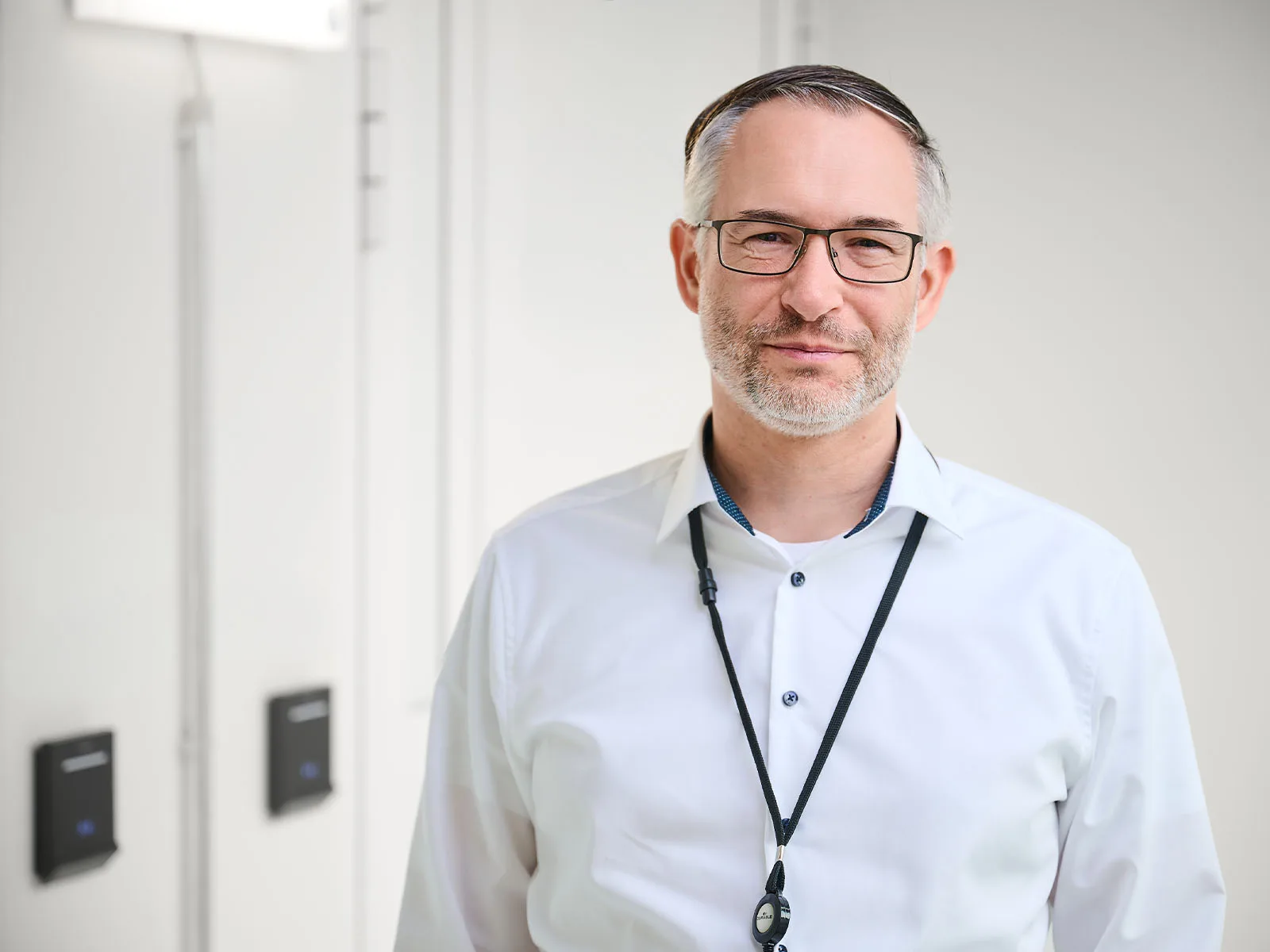
Just like the motherboard in a computer, the Hamburg Innovation Centre (IZHH) acts as a central hub connecting all the other stakeholders. The entire value chain, from the development to the operation of quantum computers, is represented here: hardware specialists meet partners from the software and applications sectors. But it is not just state-of-the-art laboratories and a fully equipped cleanroom that lie behind the brick façade. Manager Alain Pierrot knows what makes the Innovation Centre so exceptional and offers an insight into this established quantum ecosystem.
Who does the DLR QCI bring together at its Hamburg site?
We take a holistic approach to developing quantum technology, so staff at DLR QCI work alongside various partner companies. This is our ecosystem and full-stack approach. A core team at DLR QCI oversees the projects and the site. Staff from the Institute of Quantum Technology operate the cleanroom and manage the ‘enabling technologies’ for the development of quantum components. Start-ups build the quantum computers in their laboratories, whilst teams from the Institute of Software Technology provide the algorithms. There is a lively exchange of ideas, which regularly gives rise to new concepts. This is also very important to us: actively promoting the transfer of knowledge and ideas.
What techniques are used to build quantum computers here?
The IZHH has two unique selling points: a focus on ion trap technology and a combination of laser laboratories and a cleanroom. The laser laboratories provide everything essential for the construction of quantum computers, such as a stable power supply, constant temperatures, extensive cooling facilities and the necessary technical gases. Ion-trap chips can be manufactured in our fully equipped cleanroom. It takes barely a minute to walk from the laboratories to the cleanroom, which saves an incredible amount of time and is one of our greatest advantages!
Do the participants motivate one another?
There is, naturally, competition amongst hardware companies. They do, of course, exchange ideas, but not as openly and informally as is typical of traditional co-working spaces. However, this competitive environment acts as a spur and thus boosts productivity.
What makes Hamburg a unique location?
Here, we are in regular personal contact with many key players in the field of quantum technologies, particularly in quantum computing: research institutions such as the university and numerous companies. Many of them are likely to be among the first to utilise quantum technologies, such as Lufthansa Technik or the Port of Hamburg. However, we generally operate on a supra-regional basis within a nationwide network. We also exchange ideas with partners abroad; some have even set up branches nearby.
“If a functioning infrastructure already exists, it needs long-term support to realise its full potential. A highly complex ecosystem does not emerge overnight.”
How has the atmosphere at the site changed as a result of the growth?
In the early days, the companies were much smaller, and I knew almost all the staff personally. It was like a big shared flat. Today, the site is larger and more professional, but that sense of community has remained. When companies come to us and say, ‘Great that it’s working again’ or ‘Thanks for sorting out the problem so quickly’, I immediately feel that special sense of optimism again. It’s something you sometimes forget in day-to-day life: whilst we don’t develop quantum computers ourselves, we do create the essential conditions that enable others to work on them. That’s why it’s all the more important to keep reminding ourselves what we’re actually contributing to here.
How can the Innovation Centre realise its full potential?
We’re receiving a lot of positive feedback from the start-ups about the premises, the technology and the other facilities. It would be a major benefit for them, the industry partners and Germany as a business location as a whole if these existing structures were utilised and expanded in the long term. Once you’ve launched a rocket that works, you should keep it running. That’s the only way it will reach the moon. If a functioning infrastructure already exists, it needs long-term support to realise its full potential. A highly complex ecosystem does not emerge overnight; bringing a rocket that is already in flight back down to Earth simply wastes fuel. We therefore wish to operate the centre in the long term so that the infrastructure we have built up can realise its full potential.
What are your personal dreams?
My hope is that one of the quantum computers developed here will achieve a genuine breakthrough and establish itself as the benchmark platform for ion-trap quantum computers, and perhaps even go beyond that. That would be an outstanding success.


